
Best time to post on TikTok for app downloads (and how to find yours)
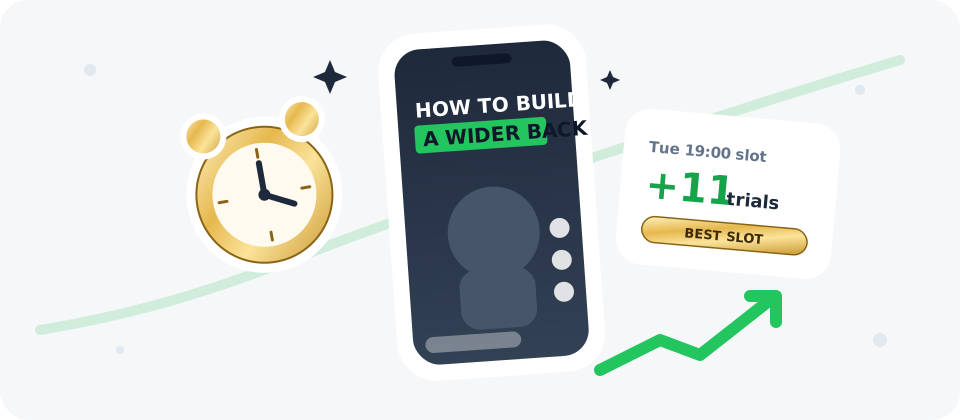
If you search for the best time to post on TikTok, you'll find dozens of charts with precise hours for every day of the week. They are built for creators chasing views. If you post to grow an app, they answer the wrong question.
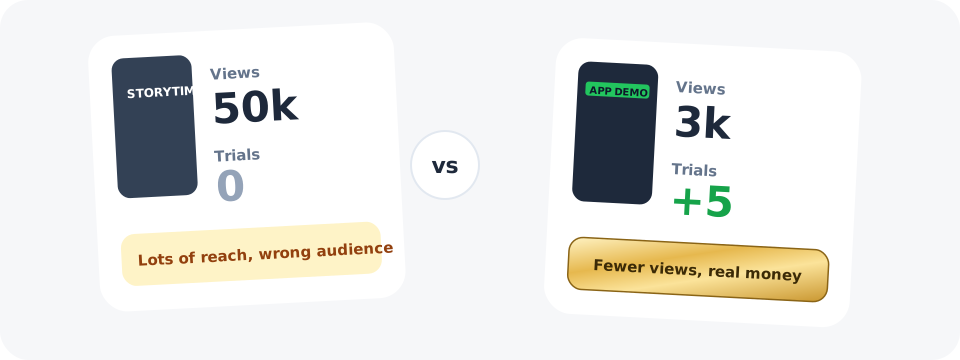
A post at the "perfect" hour can get 50,000 views and zero installs. Another at an odd hour can get 3,000 views and five trials. What you want is the hour that brings installs, trials and paying users for your account.
This guide gives you a starting point, a simple way to test, and what we learned from our own apps.
Why generic posting-time charts don't work for apps
Most published "best times" come from aggregated engagement data: when views and likes peak across many accounts. Three problems for app developers:
- Views are not installs. Engagement peaks when people scroll for entertainment. That isn't always when they're willing to download something.
- Your audience isn't the average audience. A sleep app, a workout app and a couples app have very different users, and different hours when the problem is on their mind.
- Time zones break everything. A chart in Eastern Time is useless if half your installs come from the UK, or if your views come from a country you don't sell in.
The question isn't "when do people watch TikTok?" It's "when do my viewers act on it?"
A starting point: your audience's evening
If you have no data yet, start with your target audience's evening, roughly 6 to 10 pm in their local time. It's when many people have free time, and it gives you a sensible baseline to test against.
Then adjust for what your app does:
| App type | When the problem is on people's mind | Slot worth testing |
|---|---|---|
| Sleep, alarm, morning routine | Late evening, before bed | 9 to 11 pm local |
| Fitness, workouts | Early morning and after work | 6 to 8 am and 5 to 7 pm local |
| Productivity, study | Weekday mornings, Sunday evening | 7 to 9 am, Sunday 6 to 9 pm |
| Relationships, social | Evenings and weekends | 7 to 10 pm, weekends |
These are hypotheses to test, not rules. The point is to pick slots that match when your users feel the problem your app solves.
How to find your own best time to post
You need two fixed slots per day, a few weeks, and a way to see installs per post.
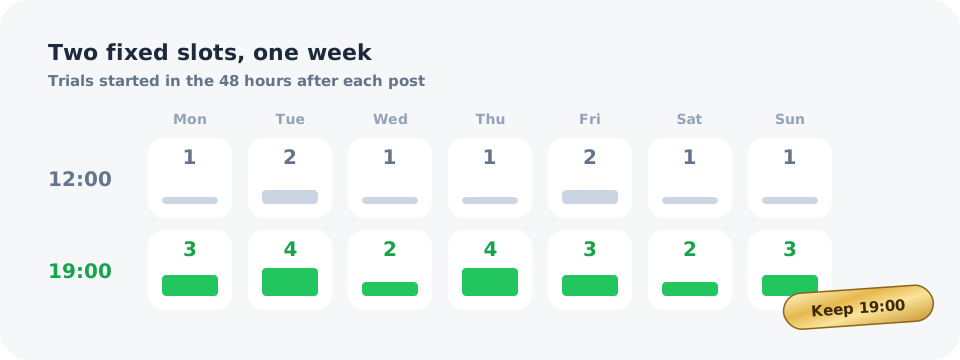
1. Pick two slots and keep them fixed
Choose two slots at least four hours apart, for example 12:00 and 19:00 in your audience's time zone. Post at the same two times every day. Changing times every day makes the results impossible to read.
2. Post comparable content in both
If one slot always gets your best videos, it will look better for the wrong reason. Rotate formats across both slots, or post two versions of the same idea on the same day.
3. Measure installs and trials, not just views
For each post, look at what happened in the 24 to 48 hours after posting compared with a normal day at that hour:
- New installs (or new customers in RevenueCat)
- New trials
- Where those installs came from (countries)
If you use RevenueCat, its charts show new customers and new trials per day. Compare days and hours with posts against similar days and hours without them. This is an estimate, not exact attribution: some viewers search the App Store later. But over a few weeks, the pattern is usually clear.
4. Wait for enough posts
Use at least three posts per slot before deciding, ideally two to three weeks. One viral video can make a weak slot look great.
5. Keep the winner, test the next slot
Keep the slot that brings more installs and trials per post. Replace the loser with a new candidate and repeat. Over a couple of months you'll find two or three slots that consistently work for each account.
What we learned from our own apps
We run organic TikTok for three of our own apps (a workout app, an alarm app and a couples app) across five accounts. In November 2026, after more than 50 posts:
- The late slot was clearly weaker on our US account. On our US workout account, posts at 23:00 UTC got about 40% less than posts at midday UTC. A generic chart would never have told us that.
- Installs came from the wrong places. In early November, most new users of one of our apps came from a country we don't target, and they started no trials. More installs is not the same as better posts.
- Most of our views stayed in a 100 to 800 range. At that size, a single post tells you very little. Patterns only showed up when we grouped posts by slot and format.
Best time to post on TikTok by day
Weekdays and weekends often behave differently. Instead of trusting a chart, compare the same slot across days in your own data. Signals to watch for:
- Monday to Thursday: routines are stable, so results from fixed slots are easiest to compare.
- Friday: evenings can shift later as people go out.
- Saturday and Sunday: mornings start later and scrolling spreads across the day. Sunday evening is often worth testing for productivity, fitness and planning apps.
Day-by-day guides, with what to test and how to read the results:
| Day | Starting slots to test (audience time) |
|---|---|
| Monday | 7 to 9 am, 7 to 9 pm |
| Tuesday | 12 to 1 pm, 7 to 9 pm |
| Wednesday | 12 to 2 pm, 6 to 9 pm |
| Thursday | 12 to 1 pm, 7 to 10 pm |
| Friday | 11 am to 1 pm, 5 to 7 pm |
| Saturday | 10 am to noon, 7 to 9 pm |
| Sunday | 10 am to noon, 6 to 9 pm |
Common mistakes
- Copying a chart in the wrong time zone. Always schedule in your audience's time.
- Judging a slot by one viral post. Wait for at least three posts per slot.
- Changing two things at once. If you change the time and the format together, you won't know which one worked.
- Ignoring where views come from. Views from countries you don't sell in won't turn into trials.
- Measuring only views. Views tell you about reach. Installs and trials tell you about money.
The short version
Start with your audience's evening. Test two fixed slots for two to three weeks. Judge each slot by installs and trials per post, not views. Keep the winners and keep testing.
Doing this by hand works, but it means lining up post times with RevenueCat data in a spreadsheet every week. That's the job Postnomics is built to do for you.
Frequently asked questions
What is the best time to post on TikTok?
There is no universal best time. A sensible starting point is your audience's evening, roughly 6 to 10 pm in their local time zone. Then test your own slots and keep the ones that bring installs and trials.
What is the best day to post on TikTok?
It depends on your audience. Weekends often behave differently from weekdays, so compare the same slot across days and judge by installs and trials, not views alone.
Should I use my time zone or my audience's time zone?
Your audience's. If most of your users are in the US and you live in Europe, schedule for US evenings, which can mean posting late at night or early in the morning your time.
How long should I test a posting time?
Two to three weeks with at least three posts per slot. With fewer posts, one lucky video can make a bad slot look good.
Why do my videos get views but no app installs?
Usually the hook attracts the wrong audience, the app appears too late in the video, or the views come from countries you don't sell in. Check where installs come from, not just how many views a post gets.